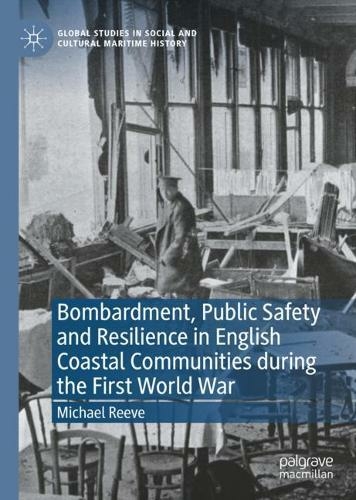
This book makes the case for a unique coastal-urban experience of war on the home front during the First World War, focusing on case studies from the north-east of England. The use of case studies from this region problematises an often assumed national or generalised experience of civilian life during the war, by shifting the frame of analysis away from the metropolis. This book begins with chapters related to wartime resilience, including analysis of pre-war fear of invasion and bombardment, and government policy on public safety. It then moves on to a discussion of power relations and the local implementation of policy related to bombardment, including policing. Finally, the book explores the ‘coastal-urban’ environment, focusing on depictions of war damage in popular culture, and the wartime and post-war commemoration of civilian bombardment. This work provides a multi-faceted perspective on civilian resilience, while responding to a recent call for new histories of the ‘coastal zone’.
Reviews
‘Essential reading for scholars wishing to understand how the British people and the British state began, separately and together, to confront the threat of mass civilian destruction which characterised the twentieth century’s total wars.’
First World War Studies, Sep 2024
‘Compelling… An exciting foray into what I hope is the first study of many on the coastal urban environment in wartime.’
Northern History, Nov 2023
‘A comprehensive and well-researched book on a topic that has achieved limited scholarly attention.’
Urban History, Feb 2023
Available here via Springer (or ask your library to purchase a copy)
 Dr. Michael Reeve